
You are currently browsing the category archive for the ‘Judaism’ category.
It’s been almost four months since my mom died, and I have to say, the third month has been the toughest so far. Everything feels harder. I miss my mom. I can’t believe she’s gone. I hurt every day, some days more than others.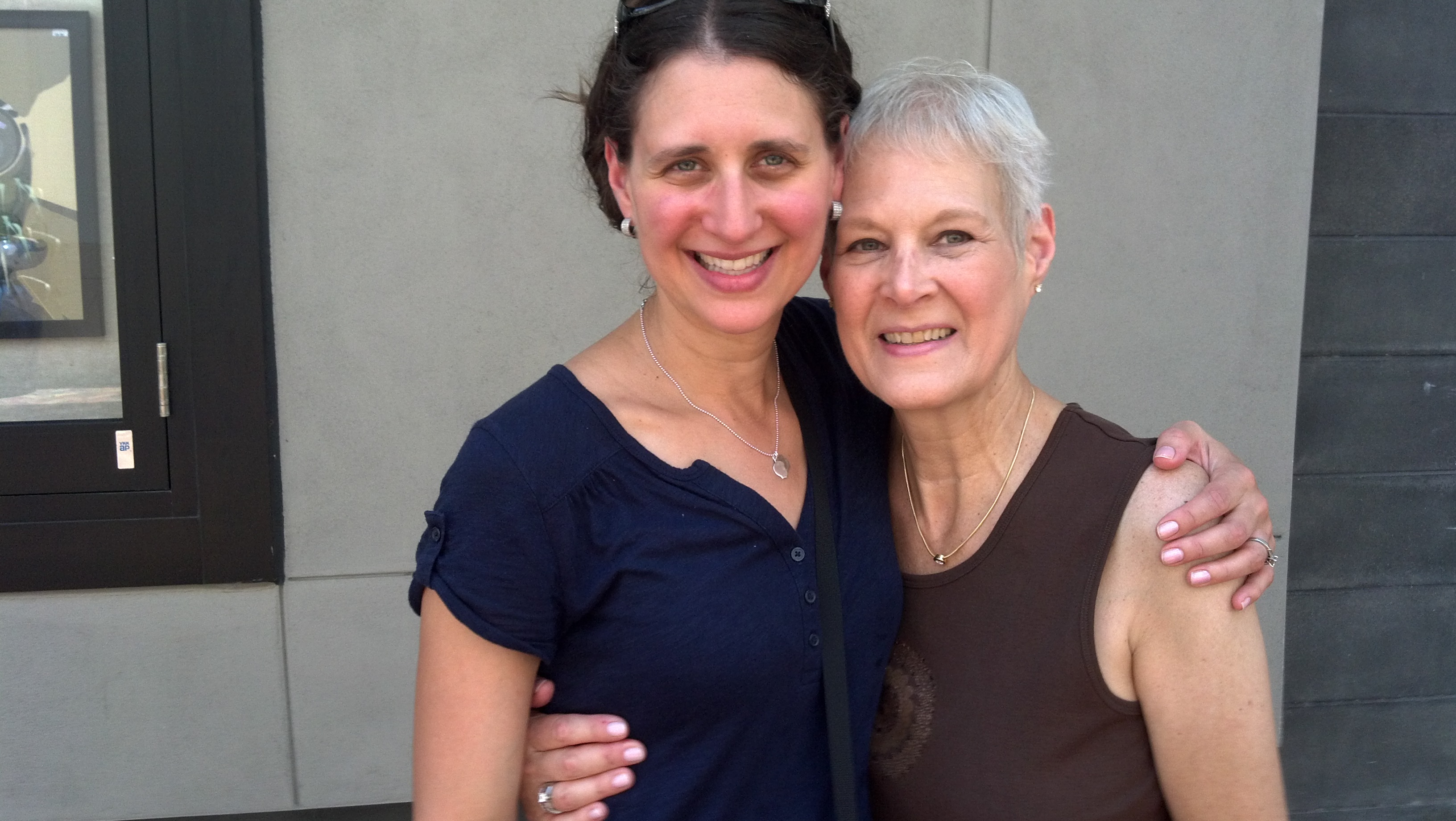
In my cycle of grief, as a wise social worker friend calls it, I’m at a stage where my nerves, and my patience, are dwindling. I feel sort of numb and punchy.
People ask me how I’m doing, and in the moment of their asking, I usually don’t know what to say. I tend to respond, “good” or “fine.”
With a few extra moments today to ponder the question, I wanted to offer a more detailed response.
1. I’m feeling un-tethered.
For 37 years, I navigated my life around my mom’s opinions, whether or not I agreed with them. Now that I have freedom from her views and expectations, it’s both liberating and guilt inducing. Being un-tethered in this way leaves me feeling sad and lost.
2. Milestones are tricky.
At my cousin’s bat mitzvah recently, three of my family members and I were saying Kaddish (the Jewish mourning prayer) for my mom or my cousin Selma. We stood in a circle, composed of more than 10 friends and family (a minyan), and recited the prayer by heart, weeping. It was a remarkable and painful moment. During special occasions and also during daily humdrum ones, happy and sad are intertwined like this for me right now.
Other milestones, such as toilet training my younger son, would have elicited emotions from my mom. I want to call her and talk about them.
My mom used to call me every Sunday and Wednesday nights like clockwork. My dad is trying to keep up this routine, but he’s by nature more fluid about communication. Sometimes I hear from him by email, sometimes we call each other in the morning. This whole business of not hearing from my mom on a regular schedule is eerie. It just feels wrong, even though I personally prefer it this way.
3. I’ve become more empathetic.
I’m more attuned now to other people’s tragedies. It feels like mourning-radar. (Mourndar!) When an acquaintance or close friend loses a loved one, I try to respond quickly. When I heard about Malaysia Airlines Flight 370 being concluded a total loss in the Indian Ocean, I was brought to tears. I just felt tremendous empathy for the victim’s families. At least my family and I knew my mom’s death was coming. These families had no warning. The victims, too: they lost their lives in an instant, possibly in an unconscious one. It’s just all such a shame.
4. Her “sunshine” lingers.
As an adult, I never cared much for “You Are My Sunshine” – my mom’s favorite song to sing to me and my sister when we were kids. She always got wistful when she sang it to us, and the whole thing just made me sad. But after she died, the song developed new meaning for me. I’m fond of it now. My younger son, Ian, adores it. We sing it together every night. Quite passionately, I might add, by his request. I often feel my mom’s presence in those moments. It’s as if she’s communicating to us through that song.
For his entire three years of life, Ian has been attached to me and clingy, but he’s taken it to a whole new level in the last few months. He’s super demonstrative toward me now. When he kisses me, he holds my face in his hands. He wants to hug me and hold my hand constantly. My mom was demonstrative, too, with her love for me and my sister. So, I see a lot of her shining through in Ian’s affections.
5. My fuse has shortened.
I don’t know if it’s sleep deprivation or mild depression, or both, but since my mom died I’ve been snippier. It takes much less for me to snap, especially at the kids. I’m aware of this, but often feel incapable of changing it. I’m trying to remove myself now from situations that I can tell I just won’t be able to handle. If it’s bedtime, for example, and I’m exhausted and the kids aren’t cooperating, I’ll just walk away for a minute. Sometimes, the kids even get the hint and change their behavior. (Sometimes.)
I used to be able to stay the course in the kid chaos, and right it. But now, I’m finding it more difficult to do that.
6. I’ve become a weather girl.
A friend told me recently she was visiting Mount Hebron, the cemetery where my mom is buried in New York. This friend offered to visit my mom, but offhand I didn’t know her exact “address.” This was a weird realization, that I didn’t know my mom’s address. But I do visit her often in my mind. And I check to see the weather in New York. My mom always got cold easily, so it upsets me when it’s cold or rainy in New York. She’s gotta be cold, I think, irrationally.
7. My worry has transferred.
For the five years between my mom’s breast cancer diagnosis and her death, I worried about her health. Now, I worry about my dad being alone in Florida. What if something happens to him? How will we know?
He had several wisdom teeth pulled recently, and I couldn’t just pop over and check in on him. He also wouldn’t answer my questions about how he felt. Was he in pain? Why wouldn’t he just tell me?! He doesn’t complain much, which can be both a blessing and a curse.
After my mom died, I thought maybe I’d free up some worry-filled mental space, but I’ve found that I haven’t. My worry has transferred from my mom to my dad.
8. My misery seeks company. Sometimes.
It’s that “mourndar” thing again. I seem to be sniffing out others who have experienced loss. At a recent event for my sons’ preschool, for example, I found myself talking with a friend who also joined the “Dead Mothers Club” in December. It sounds morose, but when he jokingly referred to us in that way, it kind of fit. Each day it hits us anew that our mothers are really gone. It feels comforting to commiserate with him and others about things like this.
And yet, there are many times I find myself retreating. I don’t return phone calls as quickly – even to closest of friends and family. Mourning, it seems, has given me a free pass to self-isolate. Many times I just don’t feel like talking. I prefer to be left alone.
9. I fear I’m falling short.
I’m torn between respecting my mom in the way she wanted me to and being here in the present for my family. In both ways, I feel as though I’m falling short.
I’m not watching frivolous TV or listening to popular music. I’m refraining from going to parties and celebrations unless they’re the size of a Shabbat dinner or for a cause I’m involved in and expected to attend. I’m saying Kaddish twice a day.
During my mom’s memorial service here in Charlotte, my rabbi said my adherence to these traditional mourning practices will help me face my grief head on, and not avoid it. I hope this will be true – that I will heal better in the long-term as a result. But it all feels so hard right now. It just feels like more loss. I miss watching mindless TV with Josh, going on date nights to the movies and listening to things other than NPR or classical stations on the radio while driving the kids to school.
10. I still can’t believe it.
I’ve heard people say this, but never fully understood what they meant until now. I simply cannot comprehend that my mom has died. I was there when she drew her last breath and when her heart stopped beating. But that doesn’t mean the reality has sunk in. Her death still doesn’t make sense to me. I find myself replaying her final moments as a way to help make it feel real, but it still doesn’t.
Rabbi Mordecai Shapiro, an Orthodox rabbi who grew up with my mom in Brooklyn and officiated at her funeral, talked to me, my sister and my father as he was cutting our ribbons and garments. He said that right now, we can only pray for understanding. Maybe, one day, we will be given a birds’ eye view of the mosaic we call life, and all of the random occurrences will make sense to us. But for now, we just have to keep the faith and trust in God.
Recently, my sister’s friend said that 10 years after her mom died she still can’t believe or comprehend it. Keeping the faith is a tricky business, I’m finding.
11. Looking ahead
When I confided to a friend recently that I was feeling blah and not like myself, she asked if I had anything to look forward to. It was a wise and thoughtful question. I probably need to focus more on future plans and happier things ahead. But my mom is not in the future. And that’s a harsh reality to face, no matter how many plans I make.
Each day is a new adventure and a new opportunity for me to experience mourning. Chasing after two young kids, I find that I don’t often have time to fully process or reflect on my state of being. It’s a bit of a moving target right now.
Therefore, if you ask me how I’m doing, I might not know how to respond. But, I’ll always appreciate you asking the question.
Xo, Jodi
May 19, 2012 – Temple Beth El – Charlotte, NC
 I have to say, I was honored when Rabbi Judy asked me to deliver today’s D’var Torah (interpretation of a Torah text). Especially in light of who would be in attendance – our Robin Farber leaders, Mitzvah Day captains, high school graduating seniors, and birthright Israel alumni. What an honor, I thought. And then I read the double Torah portion. And read it. And read it again. Oh boy, I thought. What in the world am I going to do with this?
Parashat Behar-Bechukotai finds the Jewish people about to enter Israel for the first time. God stands with Moses at Sinai and dictates the rules for entry. It’s a pivotal moment, and a difficult read, for reasons I will get into in a few minutes.
I decided to focus this d’var Torah on the leadership lessons we could learn from Behar-Bechukotai. Three stood out to me: 1) how and why leaders assert their authority, 2) how and why they set boundaries and lay out consequences, and 3) how and when they show love and support to the people they lead.
As God stands with Moses on Sinai, God knows it’s now or never. The Jewish people are about to enter Israel, which is the equivalent of paradise. If no rules or boundaries or set, it’s likely to become pure chaos.
God starts by re-asserting a sense of authority. It’s interesting that after everything God has done for the Jewish people – brought plagues down on the Egyptians, parted the Red Sea, navigated the desert for 40 years without a GPS and successfully got us to Israel – God STILL feels the need to re-assert authority: I the LORD, am your God. God says it over and again.
My husband, Josh, who’s in leadership development, says, “Executives are often deemed only as good as their most recent win or accomplishment.” The lesson: Mortals’ memories aren’t so hot. Therefore, our leaders continuously need to prove themselves to us so that we don’t forget how good they really are. It’s no different with God.
After asserting authority at Sinai, God gets down to setting boundaries. It reminds me of a discussion I had in graduate school, when I was being taught how to teach writing.
A fellow teacher in training said he didn’t appreciate when teachers gave him too many rules or guidelines. If freedom were a stage, he said, he wanted to fall off it, hard. That’s how he would best learn – or create for himself – where the edge was.
I, on the other hand, wanted to know where the edge was at all times, so that I could avoid falling off the stage. Knowing the limits of my domain was how I felt I could be the best dancer imaginable. If I were always wondering where the edge was, I wouldn’t be able to lose myself in the dance.
This other teacher and I had a difference in opinion on how to handle personal freedom. We differed in how we wanted to be led. And how we wanted to teach others.
At Sinai, I believe God realizes that individuals learn differently. But God’s only got this one shot to talk some sense into the Jewish people before they enter Israel. And, I believe God was trying to prevent us from falling off the proverbial stage.
So, God details harsh rules and consequences, as well as a few rewards. What would be the use, if after we finally entered Israel, we missed out on enjoying paradise because we foolishly partied too much, destroyed the land, or hurt each other?
God says to the Jewish people: “If you follow my laws and faithfully observe My commandments, I will…look with favor upon you and make you fertile and multiply you.” God also says: “But if you do not obey Me and do not observe all these commandments…You shall flee though none pursues”… “You shall eat the flesh of your sons and the flesh of your daughters.”
Yikes. I think God at Sinai is trying to be as harsh on us as he can be, so that we will listen. Yes, these consequences sound over the top as we read them today. But, I try to remember that there are things we too, as parents, teachers and leaders that we say too harshly. Things in hindsight that we wish we could take back or say differently. We don’t really wish to inflict psychological or bodily harm on those who follow us. We just want them to hear us and take us seriously.
At the end of this week’s parashah, we are reminded that God will love us anyway. The punishments God lists in great detail only get harsher if the Jewish people don’t listen the first, second or more times. And in the end, with repentance, we are told we can still win God back. In truth, God stays with us all the time.
To me, this is reminiscent of Maurice Sendek’s Where the Wild Things are. Sendek passed away on May 8th, but his whimsical stories and moody illustrations will leave a legacy for future generations.
The protagonist, Max, in Where the Wild Things Are, is being too mischievous one day, and his mom sends him to bed without dinner. While in his room, he imagines a whole adventure for himself in the land of the Wild Things. After a while though, he is lured back to his bedroom, by the delicious smells of the dinner his mom has made for him. In the end, his mom brings dinner to his room anyway. And it’s still hot when he gets back to it.
Members of and visitors to our congregation, our high school seniors, and current and future leaders of our temple, in light of this week’s double whammy of a Torah portion, I end by asking you to reflect on the type of leader you are, or the one you are going to become. How will you assert your authority? How harsh will you be? And how forgiving? How will you encourage others to use their gifts, their freedoms, their talents? What boundaries will you set for them? Or will you let them fall off the stage for themselves?
Thank you and Shabbat Shalom.

 Notes From Time Out