You are currently browsing the category archive for the ‘Health’ category.
It’s been almost four months since my mom died, and I have to say, the third month has been the toughest so far. Everything feels harder. I miss my mom. I can’t believe she’s gone. I hurt every day, some days more than others.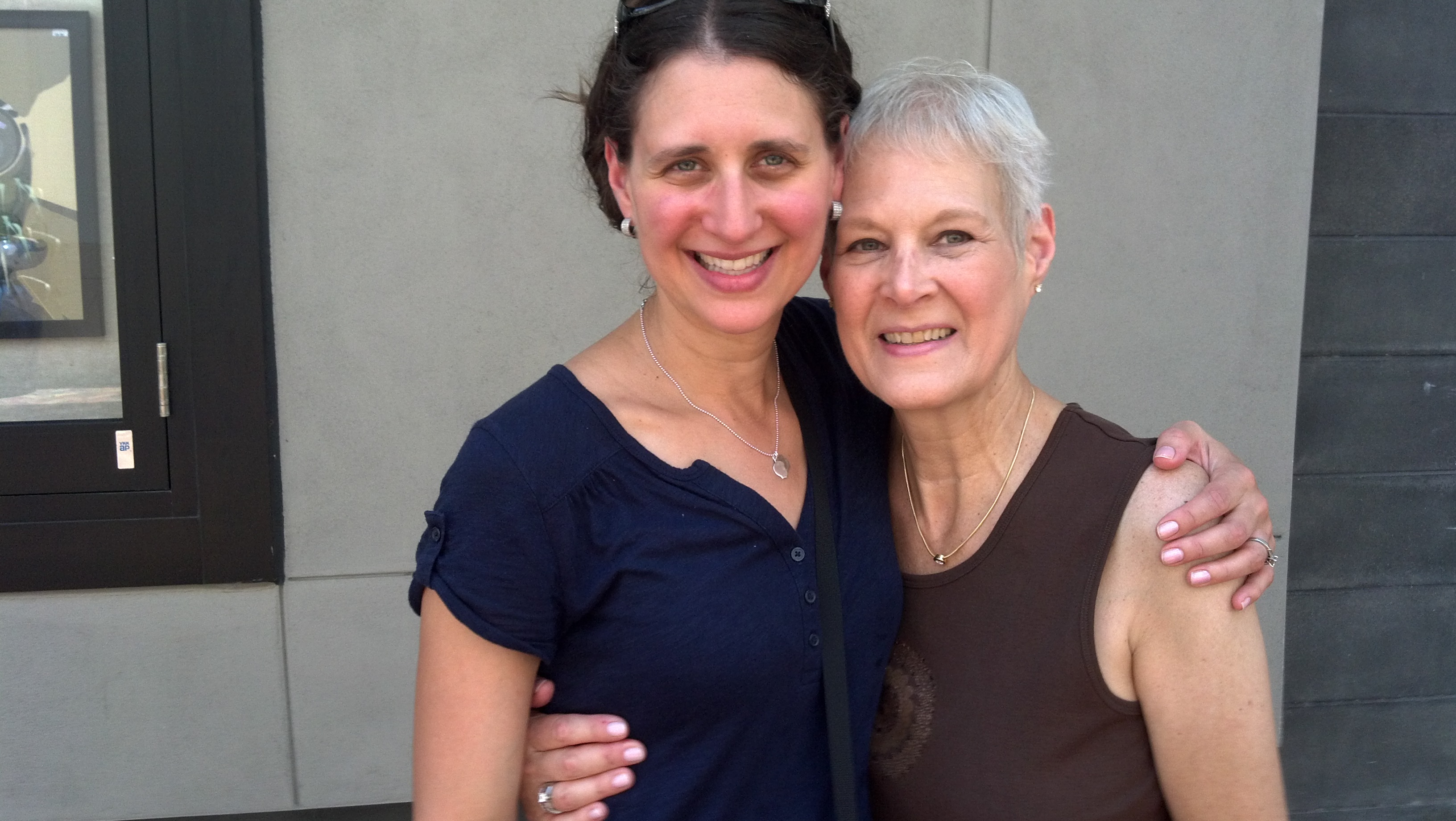
In my cycle of grief, as a wise social worker friend calls it, I’m at a stage where my nerves, and my patience, are dwindling. I feel sort of numb and punchy.
People ask me how I’m doing, and in the moment of their asking, I usually don’t know what to say. I tend to respond, “good” or “fine.”
With a few extra moments today to ponder the question, I wanted to offer a more detailed response.
1. I’m feeling un-tethered.
For 37 years, I navigated my life around my mom’s opinions, whether or not I agreed with them. Now that I have freedom from her views and expectations, it’s both liberating and guilt inducing. Being un-tethered in this way leaves me feeling sad and lost.
2. Milestones are tricky.
At my cousin’s bat mitzvah recently, three of my family members and I were saying Kaddish (the Jewish mourning prayer) for my mom or my cousin Selma. We stood in a circle, composed of more than 10 friends and family (a minyan), and recited the prayer by heart, weeping. It was a remarkable and painful moment. During special occasions and also during daily humdrum ones, happy and sad are intertwined like this for me right now.
Other milestones, such as toilet training my younger son, would have elicited emotions from my mom. I want to call her and talk about them.
My mom used to call me every Sunday and Wednesday nights like clockwork. My dad is trying to keep up this routine, but he’s by nature more fluid about communication. Sometimes I hear from him by email, sometimes we call each other in the morning. This whole business of not hearing from my mom on a regular schedule is eerie. It just feels wrong, even though I personally prefer it this way.
3. I’ve become more empathetic.
I’m more attuned now to other people’s tragedies. It feels like mourning-radar. (Mourndar!) When an acquaintance or close friend loses a loved one, I try to respond quickly. When I heard about Malaysia Airlines Flight 370 being concluded a total loss in the Indian Ocean, I was brought to tears. I just felt tremendous empathy for the victim’s families. At least my family and I knew my mom’s death was coming. These families had no warning. The victims, too: they lost their lives in an instant, possibly in an unconscious one. It’s just all such a shame.
4. Her “sunshine” lingers.
As an adult, I never cared much for “You Are My Sunshine” – my mom’s favorite song to sing to me and my sister when we were kids. She always got wistful when she sang it to us, and the whole thing just made me sad. But after she died, the song developed new meaning for me. I’m fond of it now. My younger son, Ian, adores it. We sing it together every night. Quite passionately, I might add, by his request. I often feel my mom’s presence in those moments. It’s as if she’s communicating to us through that song.
For his entire three years of life, Ian has been attached to me and clingy, but he’s taken it to a whole new level in the last few months. He’s super demonstrative toward me now. When he kisses me, he holds my face in his hands. He wants to hug me and hold my hand constantly. My mom was demonstrative, too, with her love for me and my sister. So, I see a lot of her shining through in Ian’s affections.
5. My fuse has shortened.
I don’t know if it’s sleep deprivation or mild depression, or both, but since my mom died I’ve been snippier. It takes much less for me to snap, especially at the kids. I’m aware of this, but often feel incapable of changing it. I’m trying to remove myself now from situations that I can tell I just won’t be able to handle. If it’s bedtime, for example, and I’m exhausted and the kids aren’t cooperating, I’ll just walk away for a minute. Sometimes, the kids even get the hint and change their behavior. (Sometimes.)
I used to be able to stay the course in the kid chaos, and right it. But now, I’m finding it more difficult to do that.
6. I’ve become a weather girl.
A friend told me recently she was visiting Mount Hebron, the cemetery where my mom is buried in New York. This friend offered to visit my mom, but offhand I didn’t know her exact “address.” This was a weird realization, that I didn’t know my mom’s address. But I do visit her often in my mind. And I check to see the weather in New York. My mom always got cold easily, so it upsets me when it’s cold or rainy in New York. She’s gotta be cold, I think, irrationally.
7. My worry has transferred.
For the five years between my mom’s breast cancer diagnosis and her death, I worried about her health. Now, I worry about my dad being alone in Florida. What if something happens to him? How will we know?
He had several wisdom teeth pulled recently, and I couldn’t just pop over and check in on him. He also wouldn’t answer my questions about how he felt. Was he in pain? Why wouldn’t he just tell me?! He doesn’t complain much, which can be both a blessing and a curse.
After my mom died, I thought maybe I’d free up some worry-filled mental space, but I’ve found that I haven’t. My worry has transferred from my mom to my dad.
8. My misery seeks company. Sometimes.
It’s that “mourndar” thing again. I seem to be sniffing out others who have experienced loss. At a recent event for my sons’ preschool, for example, I found myself talking with a friend who also joined the “Dead Mothers Club” in December. It sounds morose, but when he jokingly referred to us in that way, it kind of fit. Each day it hits us anew that our mothers are really gone. It feels comforting to commiserate with him and others about things like this.
And yet, there are many times I find myself retreating. I don’t return phone calls as quickly – even to closest of friends and family. Mourning, it seems, has given me a free pass to self-isolate. Many times I just don’t feel like talking. I prefer to be left alone.
9. I fear I’m falling short.
I’m torn between respecting my mom in the way she wanted me to and being here in the present for my family. In both ways, I feel as though I’m falling short.
I’m not watching frivolous TV or listening to popular music. I’m refraining from going to parties and celebrations unless they’re the size of a Shabbat dinner or for a cause I’m involved in and expected to attend. I’m saying Kaddish twice a day.
During my mom’s memorial service here in Charlotte, my rabbi said my adherence to these traditional mourning practices will help me face my grief head on, and not avoid it. I hope this will be true – that I will heal better in the long-term as a result. But it all feels so hard right now. It just feels like more loss. I miss watching mindless TV with Josh, going on date nights to the movies and listening to things other than NPR or classical stations on the radio while driving the kids to school.
10. I still can’t believe it.
I’ve heard people say this, but never fully understood what they meant until now. I simply cannot comprehend that my mom has died. I was there when she drew her last breath and when her heart stopped beating. But that doesn’t mean the reality has sunk in. Her death still doesn’t make sense to me. I find myself replaying her final moments as a way to help make it feel real, but it still doesn’t.
Rabbi Mordecai Shapiro, an Orthodox rabbi who grew up with my mom in Brooklyn and officiated at her funeral, talked to me, my sister and my father as he was cutting our ribbons and garments. He said that right now, we can only pray for understanding. Maybe, one day, we will be given a birds’ eye view of the mosaic we call life, and all of the random occurrences will make sense to us. But for now, we just have to keep the faith and trust in God.
Recently, my sister’s friend said that 10 years after her mom died she still can’t believe or comprehend it. Keeping the faith is a tricky business, I’m finding.
11. Looking ahead
When I confided to a friend recently that I was feeling blah and not like myself, she asked if I had anything to look forward to. It was a wise and thoughtful question. I probably need to focus more on future plans and happier things ahead. But my mom is not in the future. And that’s a harsh reality to face, no matter how many plans I make.
Each day is a new adventure and a new opportunity for me to experience mourning. Chasing after two young kids, I find that I don’t often have time to fully process or reflect on my state of being. It’s a bit of a moving target right now.
Therefore, if you ask me how I’m doing, I might not know how to respond. But, I’ll always appreciate you asking the question.
Xo, Jodi
I have my son’s blood on my jacket, my jeans.
The phrase “falling on your face” has new meaning for our family, after Max, 4 ½, fell last Friday while running toward the playground and didn’t get around to bracing himself first. I was talking with my friend Michelle when it happened, so I didn’t witness the fall. But the aftermath was a scene from a war film.
Max rose from the ground and ran toward me wearing horror in his eyes and coughing on the blood streaming into his mouth. My younger son, Ian, clung to my leg where he’d stay during the moments it took to seek help and get Max cleaned up.
NOT AGAIN.
Last time – just seven months prior – I hadn’t seen the fall, either. It was on the stairs at camp while Max walked down to meet me at pickup. He tripped on his backpack straps and fell nose first into the banister.

Max and his crooked nose, June 2012.
By the time I reached Max at camp, the staff had already cleaned him up, and he was holding an ice pack to his freshly crooked nose. For the week it took to surgically straighten it, I fought nausea and found it difficult to look at Max below his eyes. But I didn’t witness the bloody mess. Last week, it was the initial gore whose imagery now lingers.
These things have a way of imprinting on us parents. They add lines to our brows; they take moments, perhaps years, off our lives.
The ENT calls Max an “active” child. My father was one, too. He would eventually channel his energy through baseball and basketball, which he played throughout college. But as a boy growing up in Brooklyn, he got into a few bloody messes of his own.
At three, my dad went to the butcher with my grandmother and ran outside to swing on a gate. His thumb got caught in a hinge, and the tip was almost amputated. My grandmother, while nursing this wound and many others, yelled at him: “Why are you doing this to ME?”
The boo boos that rapidly heal on our children leave longer-lasting marks on their parents. The wrestling, rough-housing, falls and blood are all new to me having grown up with a sister and no brothers. My sister’s falling off her bike and breaking her hand was the only substantial injury I recall from both of our childhoods. I’ve already sought emergency medical care for Max twice, and he’s not even five yet.
People say boys are easier to raise – especially compared to girls’ hormones. But the grisliness of boys’ childhood injuries is emotionally wrenching for parents, too.
On Friday, after he was all cleaned up, a whole-body hug seemed to recharge Max. He smiled and asked if there would be a TV at urgent care; after all, there had been one in the emergency room over the summer. Children are more resilient than their parents. He reminds me of this often.
I practiced yoga breathing the rest of the afternoon and recharged with a bear hug of my own – from my husband. In the days that followed, I was grinding my teeth to the point of a tooth ache.
When surrounded by our children, there’s no time for parents to be visibly stressed. Those expressions must wait – often for subconscious moments. My dentist asked me recently if my gums and teeth felt more sensitive after stress. This time, the answer was evident.
This time, the urgent care doctor and Max’s ENT both came back with good news: Max broke only capillaries in his nose. A week after the bloody mess, the only scars remaining are of the mental variety. We were lucky.
The washing machine has lifted all evidence of blood from our clothes. I wish it were that way with my memory, too.
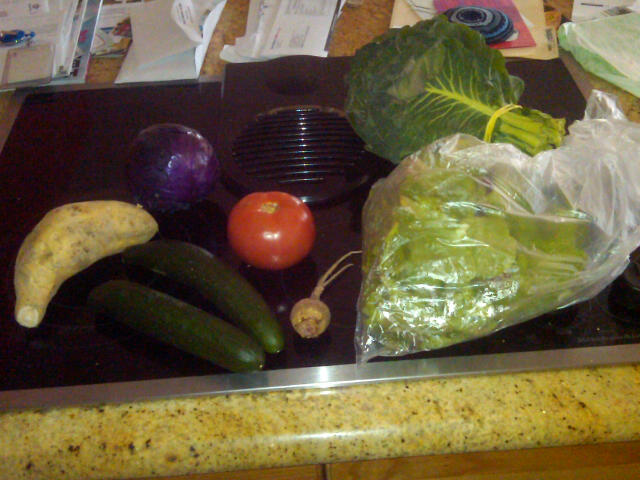
What we purchased this weekend at the farm.
I just spent $456 on vegetables. I signed up for an organic CSA. Basically, I bought a ½ share of a farm’s summer crop. Every other week from May through October, a box of local, freshly picked, certified organic produce will be delivered to my temple – where I happen to work, anyway. How great is that?
Josh and I took the family to the farm this past weekend to take a tour and go shopping at their market. It was windy and we were late, so we pretty much missed the tour. But in our brief time there, we saw all we needed to: Drip irrigation (which was created in Israel!), vibrant mixed greens sprouting, a huge compost, and beautiful communal buildings for events and group dinners.
The clincher was learning that the farm sends out an e-newsletter on Thursdays before deliveries. It lists the foods that will be in the next delivery and gives recipes for cooking some of the more obscure items. This way I can still plan ahead and shop over the weekend.
A few of our friends have signed up too, and we’re going to share best practices. A CSA support group of sorts. Veggies united!
I don’t think I’ve ever been this excited about produce before. But it’s more than that. It’s Jewish ethics. Reducing our carbon footprint. Supporting a wonderful, local farm. Veggie philanthropy! And it’s an interactive way to teach our children where their food comes from.
Hopefully, Max will actually try the collards next time. He turned them away this week, even though they were covered in peanut sauce. But I wasn’t upset. It meant more for me! Who knew collards and crunchy peanut butter would make such delicious partners. Can’t wait to see what else I learn this summer!
Recipe for Greens in Peanut Sauce
Care of Poplar Ridge Farm
1 medium onion (I didn’t have one on hand, so I didn’t use it)
2-3 cloves of garlic
1 medium tomato, diced (optional, I used it)
½ tsp ground coriander (I didn’t have this, cumin or cloves, so I left them out)
½ tsp ground cumin
¼ tsp salt
1/8 tsp ground cloves
1 lb kale, collards or turnip greens (I used collards, I think. It may have been kale…I’m a veggie in training!)
2-3 tbsp chunky peanut butter
1-2 tsp hot water
In a large pot, sauté onion and garlic in 1 tbsp oil. Add tomato and simmer 2-4 minutes.
Add greens and steam until greens are soft but not mushy. Avoid overcooking. Stir occasionally to coat greens with the spices.
Combine peanut butter and water and add to greens at the end of the cooking.
Enjoy!
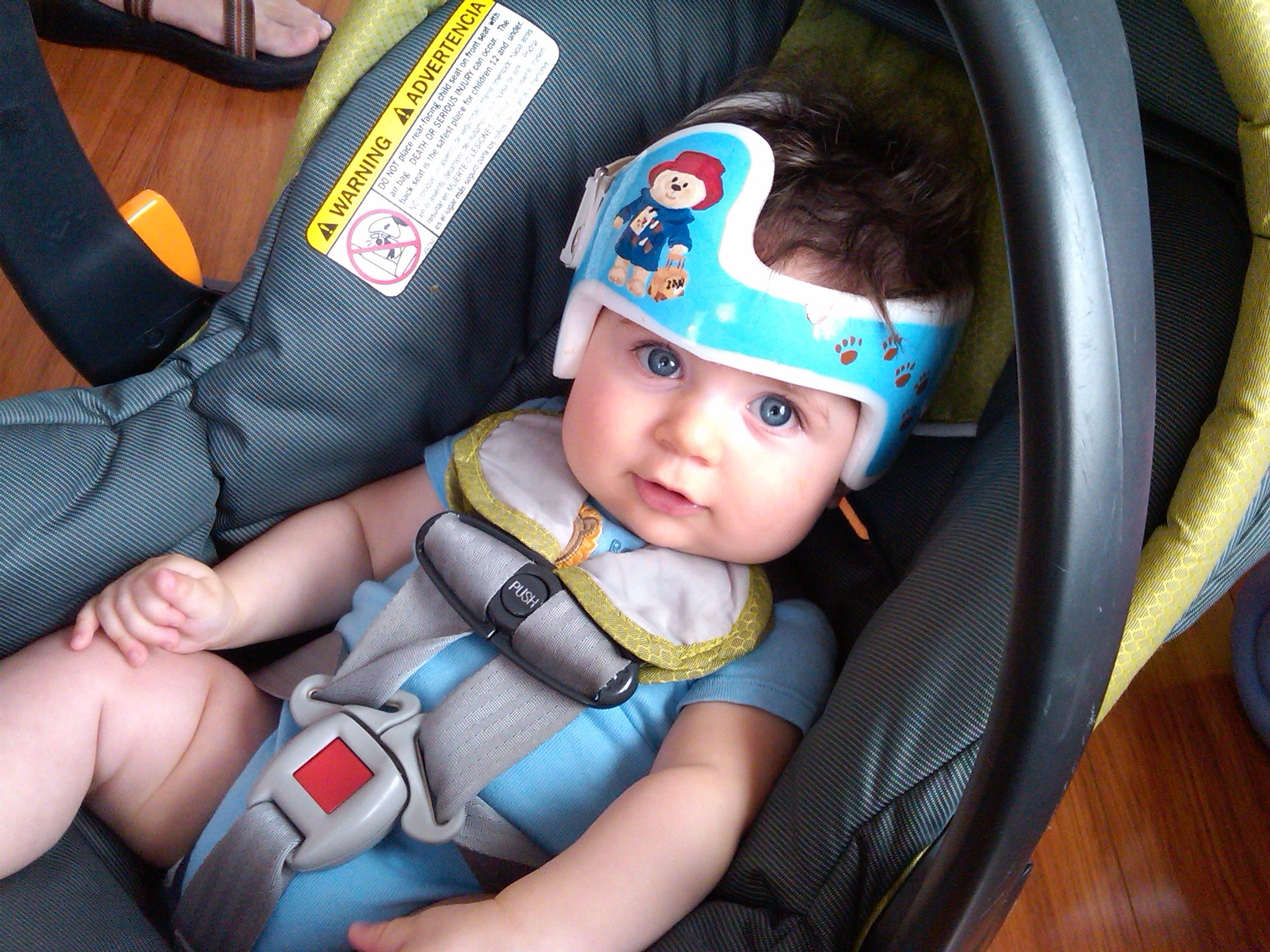
Ian and his Paddington Bear-painted cranial band.
When my older son, Max, was about eight months old, we had a play date in the children’s section of Barnes & Noble, near the Thomas the Train table. The other boy was a toddler and was busy at play with the trains. I held Max as I chatted with the toddler’s mom. At one point, the boy took a train in his hand, and in his excitement to show it to Max, chugged it at full force into Max’s head. I saw it coming with maybe a second to spare, and I braced both Max and myself for the impact. With my eyes squeezed tight I heard the thunk of metal against…plastic. For Max was wearing his cranial band, and it saved the day.
When my husband and I first learned Max needed a cranial band, we had many worries: Was the flatness at the back of his head really just a cosmetic concern? Would re-molding his skull affect his brain, too? What did we do wrong? Could it have been uterine positioning? Too much sleeping on his back and reclining in the bouncy seat? Would people make fun of him while he wears it? Would they wonder what’s wrong with our precious child?
We learned over time and from the birth of a second flat-headed son, that yes, my funky, T-shaped uterus could be blamed for squashing my sons’ heads. (Add it to the list of things they’ll blame me for in the future.) And no, the reshaping of their crania does not appear to have changed our sons’ behaviors or mental capacities, not one bit. (Max is still too smart and mechanical a three year old for his own good…turning on the TV and stereo equipment himself, reciting prayers in Hebrew, I could continue bragging, but I’ll stop now.)
We’ve found that most people don’t poke fun at the bands; they just ask a lot of questions. They call them helmets. Head bands. They bless my sons’ hearts. And they wonder about the bands. What they’re for.
As a result, I’ve become a novice cranial band educator. I explain its length of wear (about 3 months, at least for our kids) and other details. Did you know, for example, that the American Academy of Pediatrics’ Back to Sleep Campaign in 1992, which re-directed parents to put their kids to sleep on their backs instead of their tummies, has resulted in a dramatic increase in cases of plagiocephaly, the medical term for malformation of the head?
I also commiserate with parents whose children wear the bands. We find each other, sigh in relief and smile. We chuckle together about our initial worries. We agree: It’s really not that bad once you get used to it.
Now that I am used to it and almost finished with two experiences, my worries are smaller in scale, though more numerous (as I guess it is with all parents as they gain more experience and their families expand). I worry about Ian sleeping with un-socked feet. Since air can’t flow out of his covered head, it must escape from his feet. Will he therefore be cold now that it’s autumn?
Cranial bands, like all unexpected but necessary medical devices, are shocks at first but then settle in to normalcy. Ian hardly notices he’s wearing it. When I take off the band, he’s enamored by it and wants to chew on it. The hardship often lands more on parents of band-wearing infants than on the infants themselves.
To reduce the stark whiteness of the naked bands, we found a wonderful local artist to paint them. I convinced myself both times that the bands were more like wearable artwork than medical devices. (By the way, the brand name is “Doc Band” and it’s generically called a cranial orthosis. So essentially, my kids wore orthotics on their heads instead of in their shoes!)
Max took to the band seamlessly, mid-winter. Ian got his over the summer in the Southeast, so we struggled to keep him cool, and he had a few tough nights learning how to sleep in it. We made several mad dashes to baby stores to get lightweight sleep sacks and long footless PJs, which were equally hard to find. (The Children’s Place and Buy Buy Baby, FYI, were most helpful.)
Similar to the other kind of orthotics, the band can smell like stinky feet if perspiration isn’t wiped away every several hours and cleaned with alcohol daily. But those tasks become part of diaper change and bathing routines, and are hardly remarkable after a while.
Ian is now down to his last week. His band therapist has reached plastic; there is no more foam for her to carve away. The molding of his head is complete. The curve to the base of his neck looks somewhat constructed, not wholly natural or full. But it’s within the realm of normal. If he chooses to shave his head as an adult, it will look as handsome as the rest of him. And that’s what we wanted.
The funny thing about Max and Ian both having had flat infant heads that were corrected, is that their heads will still have similar shapes. Their somewhat curved noggins will be one more thing for them to have in common as brothers.
The experience could have been much worse: Our insurance was stellar three years ago, so with Max I believe we paid a co-pay for a band normally running several thousand dollars. For Ian as well, even though the economy has greatly changed our insurance coverage (among many other things in life and the world) the fees were still nominal, several hundred dollars, in comparison to the full cost.
We live only 25 minutes away from the Cranial Technologies office www.cranialtech.com, so the commute to the initial weekly then biweekly adjustments weren’t that much of a hassle. A decade ago, initial measurements were taken by plaster molding: A torturous process with lots of screaming, I assume by both infants and their parents. Now, children are fitted digitally. They wear stockings over their faces looking like robbers, as five digital cameras make picture composites of their heads.
Our therapists were lovely. One is the daughter of a cancer patient and a parent of a young son. We had plenty to talk about during the brief check-in appointments.
If you are reading this blog post anticipating your child needing a band, or struggling through initial sleep or other adjustments, take a deep breath. You will all get used to it. A friend whose son is a cranial band graduate now rests the retired band on a teddy bear in her son’s bedroom. It has become part of her family’s folklore, one of those things that make her child unique. Your child’s band will, too.
Max recently asked me of Ian’s band, “Can he play football in it, Mom-Mom?” And I informed him that cranial band or not, neither of them will be playing football for as long as I can help it. (Have you seen those players carted off fields with injuries so bad they can’t walk off themselves? Back in my high school cheerleading days, we had to move aside more than once for ambulances to reach athletes.)
“But I like playing football with Daddy,” Max replied.
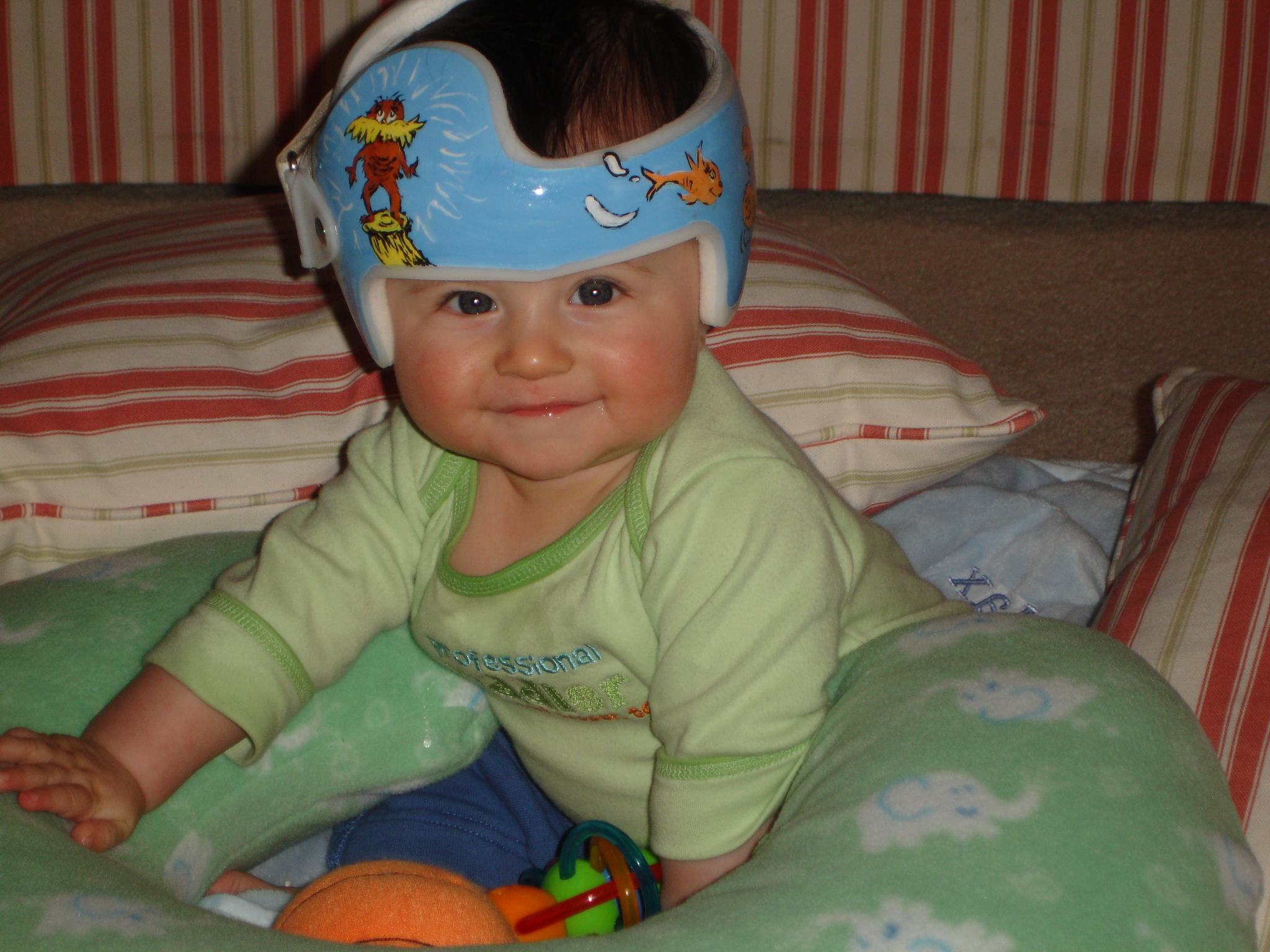
Max at 7 months in his Dr. Seuss-themed band
See what I mean? As a parent I have bigger things to worry about than my infant sons wearing cranial bands. Max doesn’t even remember his; that’s how big of a scar it left on him. And now he says he wants to play football. Real, scary, football. Remolding infant heads is the least of it.
As a worried mom, I know I won’t always be able to protect my boys. I know there are bigger things than Thomas toy trains that could potentially hurt them. And that their problems won’t always be fixable in three short months, as with the cranial band. So I’m looking to these experiences as moments to take pause and be thankful for fixable problems, small moldable heads and cranial orthotics.
 Notes From Time Out