You are currently browsing the monthly archive for November 2011.
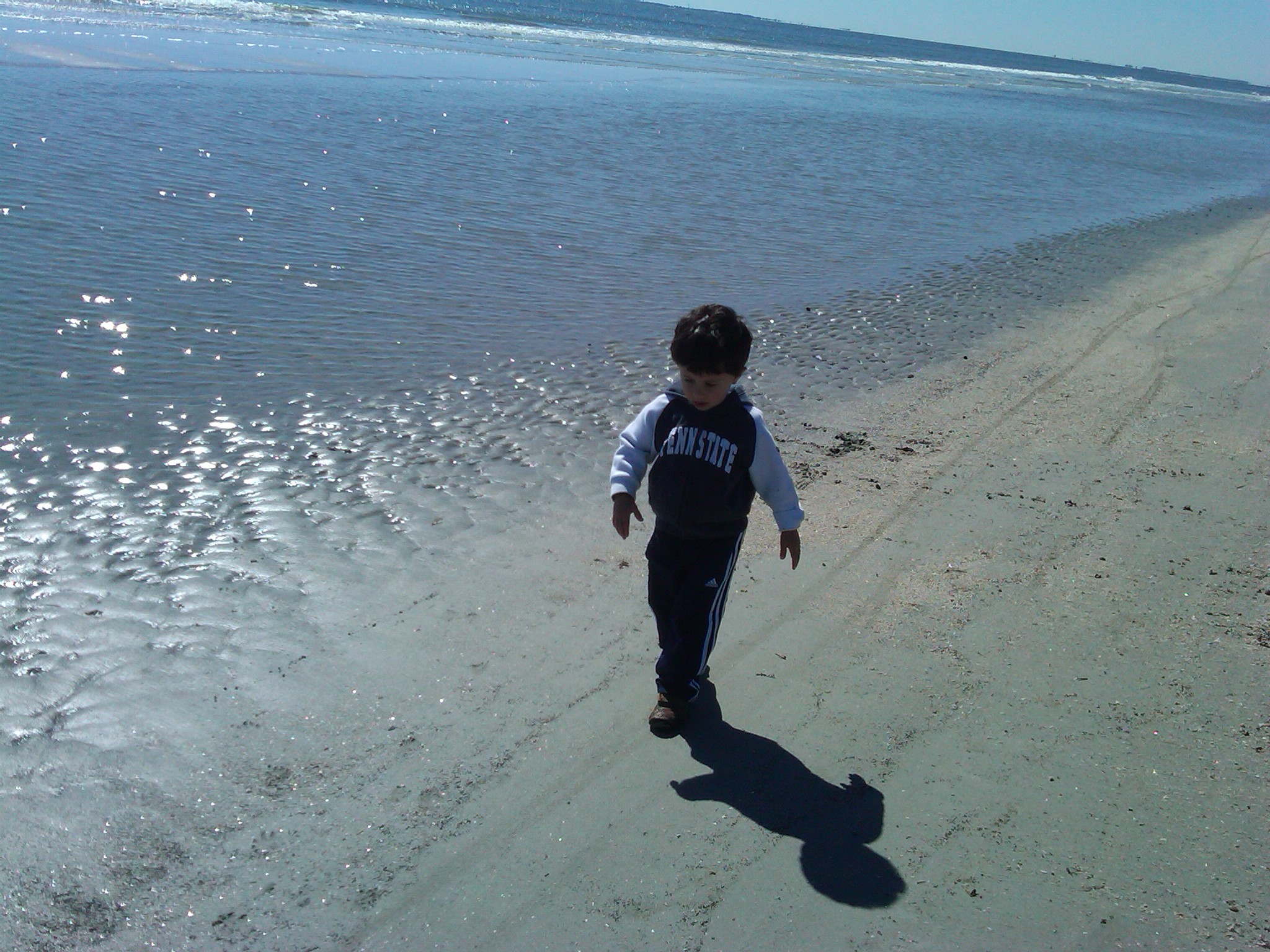
Future Nittany Lion?
When I first visited Penn State, in 1991, we were touring schools for my older sister. All I remember from that first look at Happy Valley, besides for thinking the campus was beautiful, was what happened during the walking part of the tour.
I was walking near another tour participant when he dropped something on the ground. He littered. Or he just dropped something accidentally and kept walking. But a random Penn Stater walking in the opposite direction stopped that person on our tour and encouraged him pick it up. The message: We don’t litter at Penn State. I was impressed. This place must really mean something to people.
My sister, and then I, both attended the school. For me, it had nothing to do with football. The English department was stellar, and they let me waffle for two years before declaring my major. I took graphic design, economics, cinema studies, ballroom dance and lots of writing classes. I had a blast.
I attended most football games during my four years there, as well as a wrestling match, volleyball games and swim and diving meets. I volunteered for the overall communications team of Dance Marathon, the large student-run philanthropy in the country. (Permit me one moment to brag: The students raised $9.56 million last year alone for The Four Diamonds Fund at Penn State Hershey Children’s Hospital, which helps kids with cancer and their families.)
I remember thinking Penn State was the New York City of colleges: Whatever you’re interested in, there’s a good chance you’ll find the best of it there.
Which isn’t to say you won’t also find the worst. As we all came to learn this past week, there was some heinous stuff going on behind the scenes at Penn State. While it’s hard to still think about Penn State as a Utopia, I can’t forget the Utopian experience I had there for four years. Or the tens of thousands of hard-earned dollars my family invested in my and my sister’s education there. Or how the reputation of my college degree is now on the line.
Pride and memory and the demand for justice make for awkward bedfellows. We did not ask for this new reality of Penn State, just like those boys didn’t ask to be abused. And yet that’s what we got. I know I can speak for countless alumni and students when I say we are going to help restore the sense of honor at our school and make sure the wrongs get righted…to the extent, of course, that we can.
For nothing is going to restore those boys’ innocence. Nothing is going to turn back time and have the leaders we all trusted do the right and honorable thing. But we can help prevent this from happening again. Our eyes have been opened to horrors, and now we all must heal…and move forward.
In 1996, while I was on campus, a State College resident named Jillian Robbins opened fire on the HUB lawn, killed student Melanie Spalla and wounded student Nicholas Mensah. From the depths of our despair at that time emerged a hero: An honors student, Brendon Malovrh, saw what Robbins was doing and disarmed her before she could shoot more people. When Robbins tried to stab Malovrh and stabbed herself instead, Malovrh created a tourniquet out of his own belt and treated her leg. I was in the honors college at the time, and yes, I felt proud of Malovrh.
JoePa was Penn State’s hero for six decades, but a new Penn State hero will rise out of this situation as well. One positive outcome already: A number of alumni have mobilized to raise money for RAINN: Rape, Abuse and Incest National Network. Their goal is to raise more than $500,000, or $1 for each Penn State alum. They’re already at more than $350,000.
Like most Penn Staters, I have been devouring the media coverage. The other day my sister forwarded me an interesting piece from the Daily Collegian, Penn State’s student paper. It mentions how the victims are feeling about JoePa’s termination and the community’s response.
Ben Andreozzi, the lawyer representing some of the alleged victims, said, “These victims do not live in a bubble.” They too are effected by JoePa’s brash dismissal, by the students’ rioting, by the excessive media coverage. “The school let the victims down once,” he said, “and I think they owed it to the victims to at least gauge how the immediate termination decision would impact them as opposed to Mr. Paterno’s resignation at the end of the year.”
The psychology involved in this case is complex. The “right” course of action during the aftermath is and will continue to be different for different parties involved. My head is spinning when I think about the victims, the leaders, the many, many thousands of people affected – personally, and tangentially. And it’s only going to get more prickly from here, as further details emerge and legal proceedings continue.
Penn State pride is a wonderful, albeit tricky thing. It can inspire greatness in people and organizations; yet, it must not be allowed to cloud our judgment. We owe it to ourselves, and to those entrusted in our care, to ensure that Happy Valley also remains High Road Valley.
As a friend and fellow alumna told me the other night: Even with the tarnish, the embarrassment and downfall this past week, when pictures of downtown State College come on national TV, her heart surges, and she can’t help but smile. It’s just that special of a place.
Do we defend the alleged abuse of those boys and the actions our leaders failed to take? In no way, shape or form. Do we defend the rest of the school and its efforts from here forward to rebuild its reputation? Absolutely.
Links to other pieces of potential interest:
A letter to our Members – from the Penn State Alumni Association
To non-Staters, By Beth Painter – from Facebook
Lawyer criticizes Board of Trustees’ decision to fire Joe Paterno – from the Daily Collegian
Proud to Be a Penn Stater – grassroots alumni fundraiser for RAINN
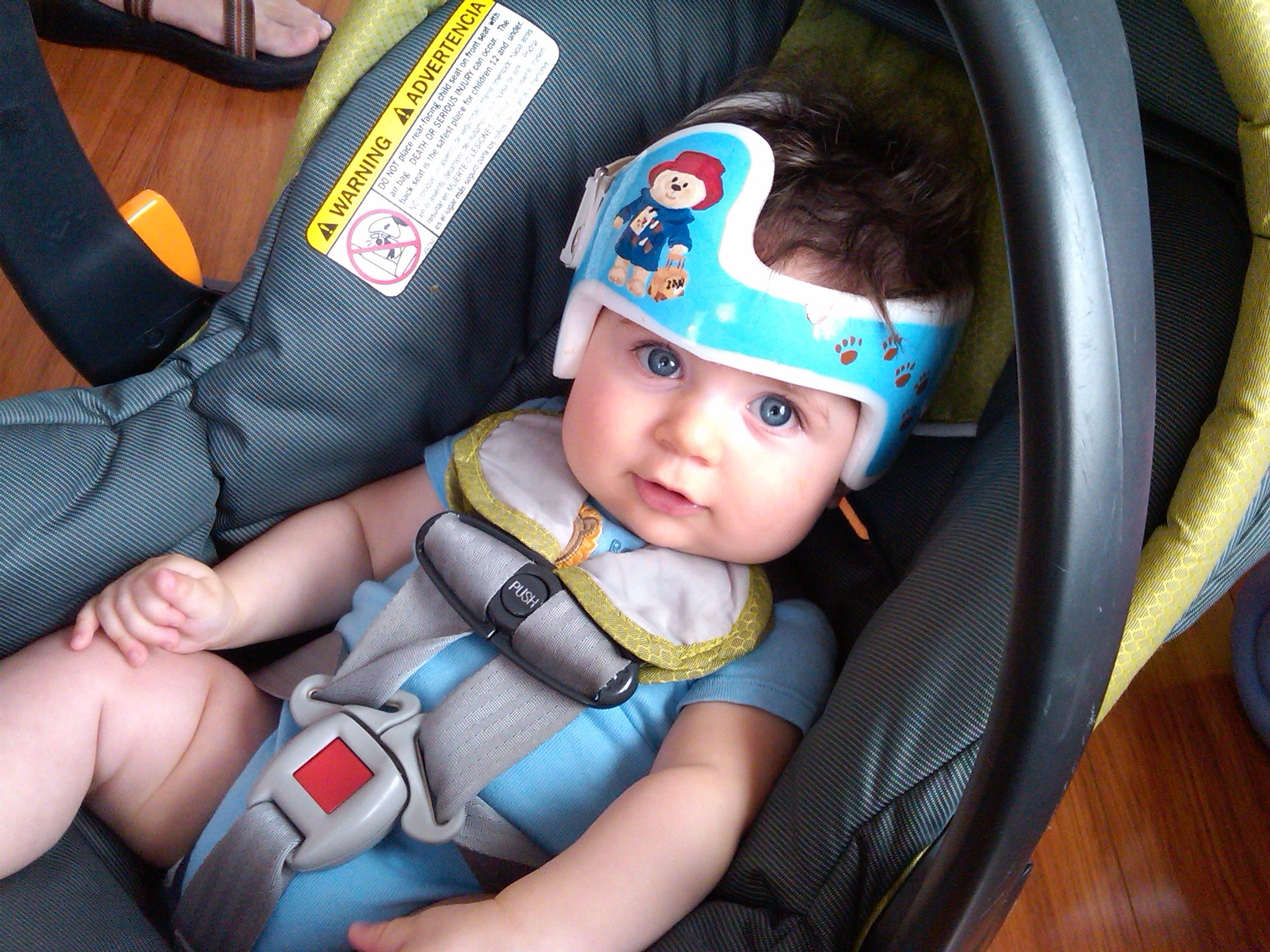
Ian and his Paddington Bear-painted cranial band.
When my older son, Max, was about eight months old, we had a play date in the children’s section of Barnes & Noble, near the Thomas the Train table. The other boy was a toddler and was busy at play with the trains. I held Max as I chatted with the toddler’s mom. At one point, the boy took a train in his hand, and in his excitement to show it to Max, chugged it at full force into Max’s head. I saw it coming with maybe a second to spare, and I braced both Max and myself for the impact. With my eyes squeezed tight I heard the thunk of metal against…plastic. For Max was wearing his cranial band, and it saved the day.
When my husband and I first learned Max needed a cranial band, we had many worries: Was the flatness at the back of his head really just a cosmetic concern? Would re-molding his skull affect his brain, too? What did we do wrong? Could it have been uterine positioning? Too much sleeping on his back and reclining in the bouncy seat? Would people make fun of him while he wears it? Would they wonder what’s wrong with our precious child?
We learned over time and from the birth of a second flat-headed son, that yes, my funky, T-shaped uterus could be blamed for squashing my sons’ heads. (Add it to the list of things they’ll blame me for in the future.) And no, the reshaping of their crania does not appear to have changed our sons’ behaviors or mental capacities, not one bit. (Max is still too smart and mechanical a three year old for his own good…turning on the TV and stereo equipment himself, reciting prayers in Hebrew, I could continue bragging, but I’ll stop now.)
We’ve found that most people don’t poke fun at the bands; they just ask a lot of questions. They call them helmets. Head bands. They bless my sons’ hearts. And they wonder about the bands. What they’re for.
As a result, I’ve become a novice cranial band educator. I explain its length of wear (about 3 months, at least for our kids) and other details. Did you know, for example, that the American Academy of Pediatrics’ Back to Sleep Campaign in 1992, which re-directed parents to put their kids to sleep on their backs instead of their tummies, has resulted in a dramatic increase in cases of plagiocephaly, the medical term for malformation of the head?
I also commiserate with parents whose children wear the bands. We find each other, sigh in relief and smile. We chuckle together about our initial worries. We agree: It’s really not that bad once you get used to it.
Now that I am used to it and almost finished with two experiences, my worries are smaller in scale, though more numerous (as I guess it is with all parents as they gain more experience and their families expand). I worry about Ian sleeping with un-socked feet. Since air can’t flow out of his covered head, it must escape from his feet. Will he therefore be cold now that it’s autumn?
Cranial bands, like all unexpected but necessary medical devices, are shocks at first but then settle in to normalcy. Ian hardly notices he’s wearing it. When I take off the band, he’s enamored by it and wants to chew on it. The hardship often lands more on parents of band-wearing infants than on the infants themselves.
To reduce the stark whiteness of the naked bands, we found a wonderful local artist to paint them. I convinced myself both times that the bands were more like wearable artwork than medical devices. (By the way, the brand name is “Doc Band” and it’s generically called a cranial orthosis. So essentially, my kids wore orthotics on their heads instead of in their shoes!)
Max took to the band seamlessly, mid-winter. Ian got his over the summer in the Southeast, so we struggled to keep him cool, and he had a few tough nights learning how to sleep in it. We made several mad dashes to baby stores to get lightweight sleep sacks and long footless PJs, which were equally hard to find. (The Children’s Place and Buy Buy Baby, FYI, were most helpful.)
Similar to the other kind of orthotics, the band can smell like stinky feet if perspiration isn’t wiped away every several hours and cleaned with alcohol daily. But those tasks become part of diaper change and bathing routines, and are hardly remarkable after a while.
Ian is now down to his last week. His band therapist has reached plastic; there is no more foam for her to carve away. The molding of his head is complete. The curve to the base of his neck looks somewhat constructed, not wholly natural or full. But it’s within the realm of normal. If he chooses to shave his head as an adult, it will look as handsome as the rest of him. And that’s what we wanted.
The funny thing about Max and Ian both having had flat infant heads that were corrected, is that their heads will still have similar shapes. Their somewhat curved noggins will be one more thing for them to have in common as brothers.
The experience could have been much worse: Our insurance was stellar three years ago, so with Max I believe we paid a co-pay for a band normally running several thousand dollars. For Ian as well, even though the economy has greatly changed our insurance coverage (among many other things in life and the world) the fees were still nominal, several hundred dollars, in comparison to the full cost.
We live only 25 minutes away from the Cranial Technologies office www.cranialtech.com, so the commute to the initial weekly then biweekly adjustments weren’t that much of a hassle. A decade ago, initial measurements were taken by plaster molding: A torturous process with lots of screaming, I assume by both infants and their parents. Now, children are fitted digitally. They wear stockings over their faces looking like robbers, as five digital cameras make picture composites of their heads.
Our therapists were lovely. One is the daughter of a cancer patient and a parent of a young son. We had plenty to talk about during the brief check-in appointments.
If you are reading this blog post anticipating your child needing a band, or struggling through initial sleep or other adjustments, take a deep breath. You will all get used to it. A friend whose son is a cranial band graduate now rests the retired band on a teddy bear in her son’s bedroom. It has become part of her family’s folklore, one of those things that make her child unique. Your child’s band will, too.
Max recently asked me of Ian’s band, “Can he play football in it, Mom-Mom?” And I informed him that cranial band or not, neither of them will be playing football for as long as I can help it. (Have you seen those players carted off fields with injuries so bad they can’t walk off themselves? Back in my high school cheerleading days, we had to move aside more than once for ambulances to reach athletes.)
“But I like playing football with Daddy,” Max replied.
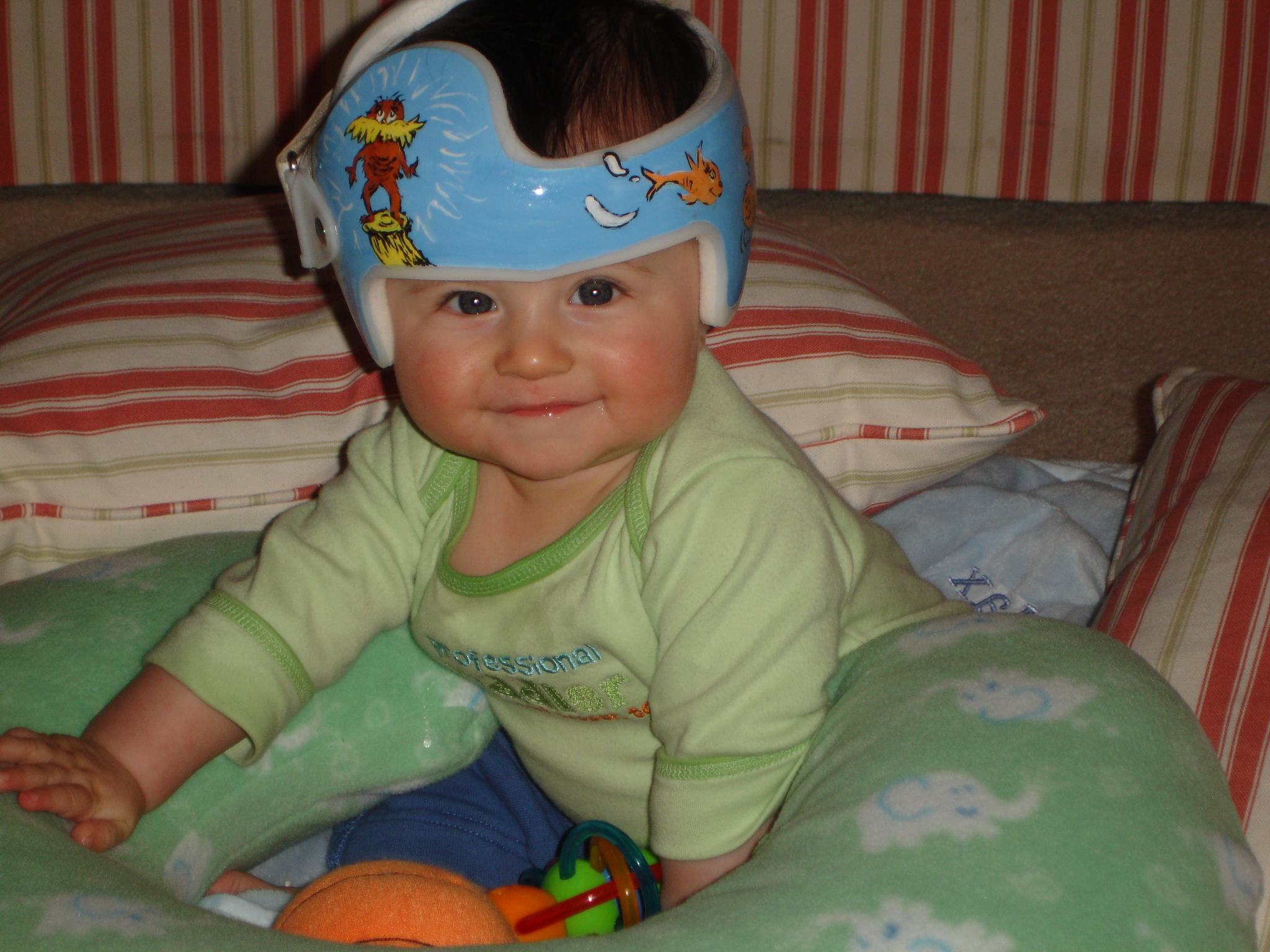
Max at 7 months in his Dr. Seuss-themed band
See what I mean? As a parent I have bigger things to worry about than my infant sons wearing cranial bands. Max doesn’t even remember his; that’s how big of a scar it left on him. And now he says he wants to play football. Real, scary, football. Remolding infant heads is the least of it.
As a worried mom, I know I won’t always be able to protect my boys. I know there are bigger things than Thomas toy trains that could potentially hurt them. And that their problems won’t always be fixable in three short months, as with the cranial band. So I’m looking to these experiences as moments to take pause and be thankful for fixable problems, small moldable heads and cranial orthotics.
 Notes From Time Out